By Aida Khazieva·Electrolysis·15 min read·Real Skin Beauty, Irvine CA·Updated October 21, 2026
Often yes, but only after a physician has checked the mole. Electrolysis treats the hair follicle, not the mole itself. If a dermatologist confirms the mole is stable and benign, a fine probe can treat the hair at its root. I never treat hair in a mole that is new, raised and changing, bleeding or irregular, and I ask for your doctor's approval first.
Quick answer
Electrolysis treats the hair follicle inside the mole. It does not remove or change the mole.
Have the mole checked by a physician or dermatologist first, and get approval for hair removal.
Never treat hair in a mole that is new, changing, bleeding, itchy or irregular. See a doctor instead.
Trimming with small scissors is the gentlest habit while you wait. Avoid plucking, waxing and shaving over a raised mole.
Laser often skips moles because they are pigmented. Electrolysis does not rely on pigment.
The Short Answer: The Hair, Not the Mole
Hair that grows out of a mole is common and usually harmless. A mole is a cluster of pigment cells in the skin, and when it sits over a hair follicle, the hair simply keeps growing through it. Many people notice that these hairs are darker, thicker or longer than the hair around them. That is why they bother people so much: one coarse hair on a cheek, chin or neck mole is easy to see in a mirror and easy to feel with your fingers.
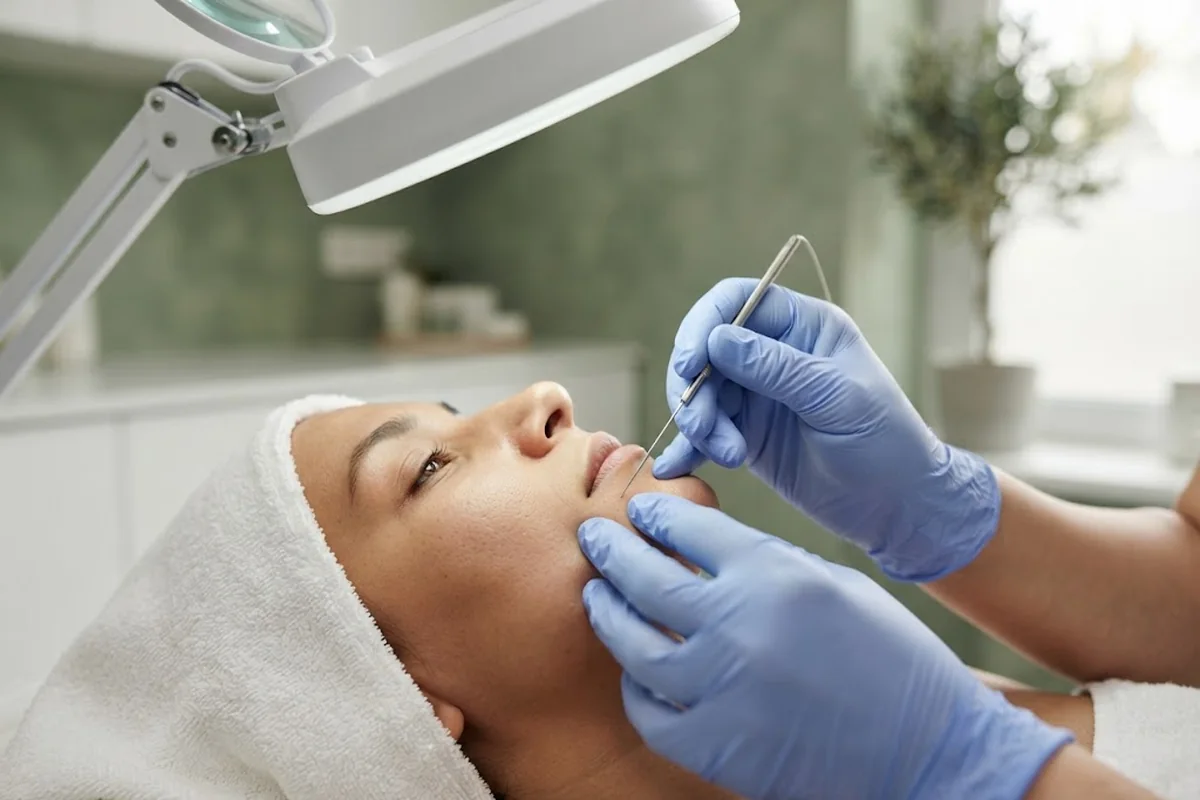
Electrolysis works on the follicle. A very fine probe slides into the natural opening of the follicle beside the hair shaft, a small amount of energy is applied, and the hair is lifted out. The goal is to treat the growth tissue at the root, not the mole itself. Electrolysis does not remove, flatten, lighten or change a mole, and it should never be presented as a way to do so.
So the honest answer has two parts. First, a hair growing from a mole can often be treated with electrolysis. Second, that only applies after the mole itself has been looked at and is considered stable and benign by a physician. In my Irvine studio I ask for a doctor's approval before I work on any hair that grows from a mole. That step protects you, and it protects the mole from being irritated before anyone knows what it is.
ImportantAn electrologist cannot tell you whether a mole is healthy. Only a physician or dermatologist can examine a mole and decide whether it needs a closer look, a biopsy or removal.
Why Hair Grows From Moles
Moles (the medical word is nevi) form when pigment cells grow in a cluster. Many moles contain hair follicles, because the skin underneath still has all its normal structures. Some moles, especially ones that have been there since childhood or that sit on the face, tend to grow a few terminal hairs. Terminal hairs are the thick, pigmented kind, as opposed to the fine, light vellus hair that covers most of the face.
Several things can make mole hairs more noticeable over time:
Hormones. The same hormonal shifts that bring new chin or lip hairs during puberty, pregnancy, perimenopause or with conditions such as PCOS can also affect follicles inside a mole.
Age. Many clients notice that mole hairs get coarser in their 40s and 50s, the same years when other facial hair changes.
Repeated plucking. Tweezing does not create new hair, but it can irritate the follicle and the mole around it. My article on whether plucking makes hair grow back thicker explains what tweezing really does to a follicle.
Contrast. A dark hair on a raised mole is simply more visible than the same hair on flat skin.
Hair in a mole on its own is not usually considered a warning sign. In fact, many people have been told over the years that a hairy mole is less likely to be a concern, but this is not a rule anyone should rely on. Any mole that changes deserves a medical check whether it has hair or not. If you want to understand the wider reasons for new facial hair, I wrote a separate guide on why women start growing facial hair.
When to See a Doctor Before Anything Else
Before any hair removal near a mole, ask yourself whether the mole has changed. Dermatologists often teach the ABCDE checklist as a simple way to notice moles that need professional attention. It is a guide for when to book an appointment, not a way to diagnose yourself.
Letter
What to look for
What it means for hair removal
A: Asymmetry
One half of the mole does not match the other
See a physician first. No hair removal until it has been examined.
B: Border
Edges that are ragged, notched or blurred
See a physician first.
C: Color
Several shades of brown, black, red, white or blue in one mole
See a physician first.
D: Diameter
Larger than a pencil eraser, though smaller moles can matter too
Mention it to your physician at your next visit or sooner.
E: Evolving
Any change in size, shape, color, height, or new itching, bleeding or crusting
See a physician promptly. Never treat a changing mole.
Other reasons to see a doctor before thinking about hair removal include a mole that is new in adulthood, a mole that bleeds after minor contact, a mole that looks different from your other moles, or a family history of skin cancer. If any of these apply, the hair is the least important part of the picture.
A physician may tell you the mole looks stable and fine to leave alone. They may also suggest removing the mole altogether, which often takes the hair with it. In that case, electrolysis may not be needed at all. If a mole is removed and a hair later grows back through the scar, that is a separate conversation for after healing, again with your doctor's approval.
Why Plucking and Cutting Are the Usual Habits
Most people with a hairy mole either pluck the hair or trim it. Both feel quick and simple. They have different trade-offs.
Plucking
Plucking removes the hair from the root, so the area looks clean for a few weeks. The problem is that the follicle stays alive and the hair returns. Each pluck also pulls on the mole and the skin around it. Repeated tugging can cause redness, small bumps, ingrown hairs or irritation of the mole. A mole that is often red or sore from tweezing is harder for a physician to assess, because irritation can change how it looks.
Trimming
Trimming with small, clean, rounded scissors is gentle and safe for most moles. You cut the hair close to the surface without touching the mole. The hair grows back within days, and the stub may still be visible, but there is no pulling and no trauma. For many people this is the most sensible long-term habit, especially while waiting for a doctor's appointment.
Shaving and waxing
Running a razor over a raised mole can nick it, and a nick on a mole can bleed more than you expect. Wax sticks to the mole and pulls on it. I generally advise clients to avoid both over a raised mole. If you shave the surrounding area, go around the mole, not over it.
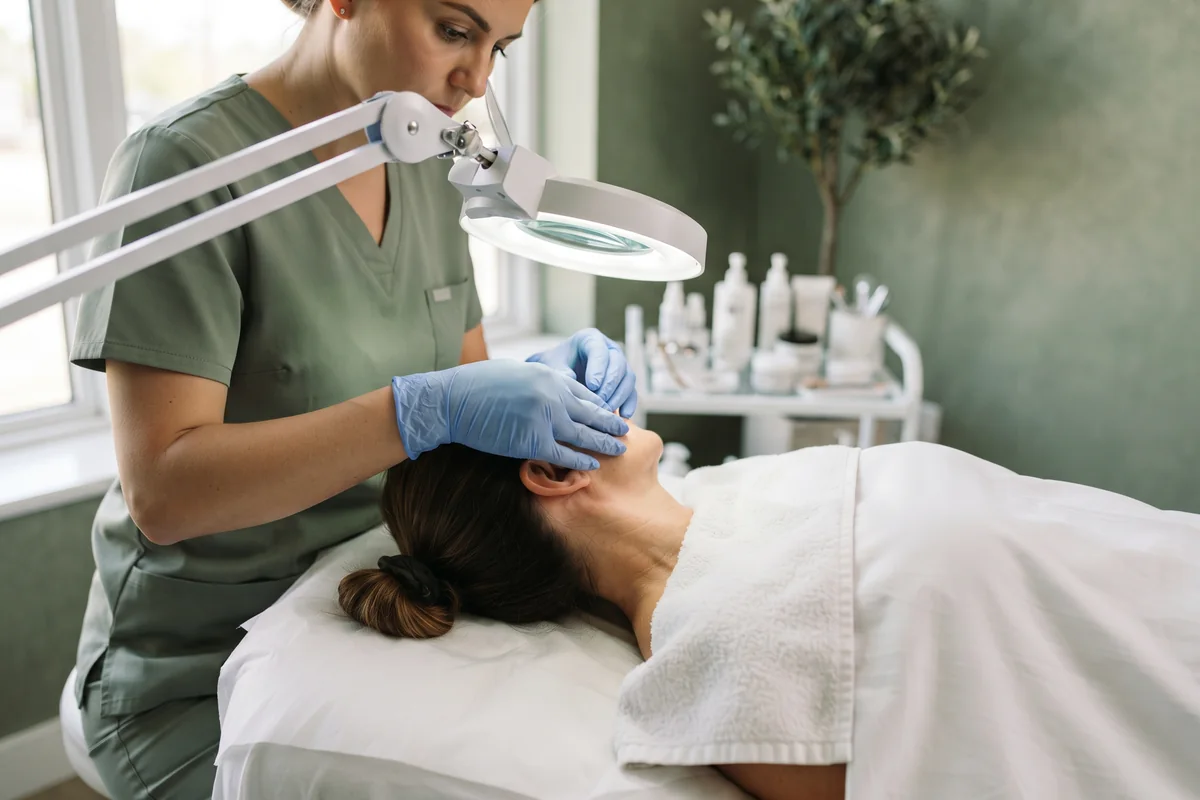
Under magnification I look at the hair angle and the skin around it. Judging the mole itself is a job for a physician.
Method
How long it lasts
Effect on the mole
My view
Trimming with scissors
Days
No contact with the mole when done carefully
The gentlest everyday option
Plucking
Two to six weeks
Repeated pulling and irritation
Best avoided on moles
Shaving
One to three days
Risk of nicks on raised moles
Go around the mole, not over it
Waxing or threading
Weeks
Pulls on the mole surface
Not recommended on a mole
Laser hair removal
Long-term reduction
Many laser providers avoid treating over pigmented moles
Ask your physician and laser provider
Electrolysis
Permanent for each treated follicle once complete
Treats the follicle only, after physician approval
A possible option for a stable, cleared mole
Why Laser Is Often Not the Answer for Mole Hair
Real Skin Beauty does not offer laser, so I have no reason to push you one way or the other here, but it is a common question. Laser hair removal works by targeting pigment. A mole is full of pigment. That is why many laser providers cover moles or skip them during treatment, and why a dark hair inside a mole is often left behind after a full laser course. The hair is not the only pigmented thing in the beam.
Electrolysis does not depend on pigment. The probe goes into the follicle opening and the energy is delivered at the root, so hair color and skin color do not decide whether it works. That is the same reason electrolysis is used for blonde, gray and red hairs that laser cannot treat. For a single hair in a cleared mole, this makes electrolysis one of the few permanent options people ask about. For a general comparison of the two methods, see my guide to electrolysis vs laser.
How I Approach Hair in a Mole at My Studio
Every electrologist has their own policy. I can only describe mine in general terms, and it is deliberately cautious.
Health history first. At the free consultation you fill in a health history form. I ask about moles, skin conditions, medications and any past skin cancer.
A look under magnification. I look at the hair and the skin around it with a magnifying lamp. This is not a medical exam. It helps me see the hair angle, how many hairs there are and whether the area looks irritated from plucking.
Doctor's approval. If the hair grows from a mole, I ask you to have the mole checked by your physician or dermatologist and to confirm that they are comfortable with electrolysis on that hair. If anything about the mole looks changed, irritated or unusual to me, I will not treat it and I will ask you to see your doctor.
Treating the hair only. Once cleared, I insert a fine, sterile, single-use probe into the follicle opening beside the hair and use a low, carefully controlled setting. The goal is to lift the hair without lifting or damaging the mole surface.
Short, gentle visits. A few mole hairs usually take only minutes. They can be done as part of a short facial electrolysis visit.
Follow-up. Hair grows in cycles, so a follicle may need more than one treatment before it stops. I check the area at each visit, and if the mole ever looks different, we stop and you see your doctor.
Some electrologists will not treat any hair from a mole, even with clearance, and that is a reasonable choice. If you are choosing a provider, my guide on how to choose an electrologist in California lists questions to ask, including how they handle moles.
With a doctor's approval, a fine single-use probe treats the follicle beside the hair, not the mole surface.
What a Session Feels Like and What to Expect
Treating a hair in a mole feels similar to treating any other facial hair: a quick warm prick or sting at the root, then the hair slides out with no pulling. Some people find the area around a mole a little more sensitive, others feel no difference. If you are worried about comfort, my article on whether electrolysis hurts covers what you can expect and what helps.
Afterward, the skin around the follicle may be slightly pink. Tiny pinpoint redness usually settles within hours. On some skin, a very small scab can form over the follicle opening in the following days. Leave it alone and let it fall off on its own. My electrolysis aftercare guide explains the routine in detail.
Stage
What is common
When to contact a professional
Right after
Mild pinkness at the follicle, slight warmth
Bleeding from the mole itself, strong pain
First 24 to 48 hours
Redness fading, a tiny bump at the follicle
Swelling that grows, pus, heat spreading
Days 3 to 7
A pinpoint scab may form and flake off
An open sore that does not heal
Weeks later
Possible regrowth of a finer hair from the same follicle
Any change in the mole's size, color, shape or height: see your physician
Do not pick at the area, and do not put makeup directly on it for the first day. Keep the area clean, and protect it from the sun, because sun exposure is one of the main things doctors suggest to limit for moles anyway.
How Many Sessions a Mole Hair Usually Needs
A single coarse hair often takes several treatments over a period of months. That is not because the treatment is weak, but because a deep, well-fed follicle can sometimes regrow a finer hair after the first treatment. Each time it returns, it is usually thinner and lighter, and eventually many follicles stop producing hair.
Hairs that have been plucked for years can be a little harder to treat, because the follicle may be distorted. That is something I see often with chin hair as well. My guide to how many electrolysis sessions you need explains the hair cycle and why patience matters.
Because mole hairs are usually few, the cost is modest. At my studio, a general facial electrolysis zone is $75 for 30 minutes, and a chin session is $65 for 30 minutes. A few hairs in a mole usually take only part of that time, and I often treat them together with other facial hairs in the same visit. The consultation, where we discuss the mole and the doctor's approval, is free.
Skin Tags, Birthmarks and Other Spots
People sometimes ask about hair on other kinds of skin growths. The same principle applies: the growth itself is a medical matter, and the hair can only be considered after it has been assessed.
Skin tags. These small, soft flaps of skin rarely have coarse hair, but they can catch on clothing or jewelry. Removing a skin tag is a medical procedure. I do not treat skin tags, and electrolysis is not used to remove them in my studio.
Birthmarks. Some pigmented birthmarks grow hair. Large or unusual birthmarks should be followed by a physician, and some doctors prefer that they are not treated at all. Ask first.
Seborrheic keratoses. These raised, waxy or rough spots are common with age. They usually do not grow hair, but if hair sits beside one, I avoid touching the growth.
Scars. Hair growing through a healed scar, including the scar left after a mole removal, can sometimes be treated once the scar is fully mature and your doctor agrees.
Freckles and flat sun spots. Flat pigment is different from a raised mole, but if it is new or changing, a doctor should still see it.
If you are not sure what a spot is, do not guess. Book a skin check with a physician and bring the hair question with you. Many dermatologists are used to it.
The health history form asks about moles, skin conditions and medications before any treatment is planned.
Common Mistakes With Mole Hair
Plucking the same hair for years. It keeps the mole irritated and does not make the hair go away.
Using a home "electrolysis" pen on a mole. Home devices are hard to control even on normal skin. On a mole the risk of damaging the surface is higher. My review of at-home electrolysis devices explains the limits.
Trying to burn or cut off the mole at home. Never do this. It risks scarring and infection and destroys the information a doctor needs.
Ignoring change because "it has always had a hair." Hair does not make a mole immune to change.
Choosing a provider who does not ask about moles. A careful electrologist will ask, look and often request clearance.
Waxing or threading over a raised mole. Both pull on the mole surface.
The easiest habit to adopt today is to stop plucking and trim instead, then book a physician appointment if you have not had a skin check recently.
Electrolysis on Mole Hair in Irvine
I have worked as a licensed electrologist and cosmetologist for more than 20 years, and I wrote a book about the profession called "I Am an Electrologist." Over that time my approach to moles has stayed the same: the mole belongs to your doctor, the hair can belong to me once your doctor is comfortable with it.
If you live in Irvine, Tustin, Newport Beach or elsewhere in Orange County and a hair in a mole bothers you, you can start with a free consultation at Real Skin Beauty, 18021 Sky Park Circle, Suite N, Irvine. We will look at the area, talk through your history and decide on next steps. If you have already had the mole checked, bring a note or tell me what your doctor said. You can read more about electrolysis at my studio or book a free consultation, or call (949) 444-6191.
Frequently Asked Questions
+ Can electrolysis remove hair from a mole?
Often yes, once a physician has examined the mole and is comfortable with hair removal. Electrolysis treats the follicle at the root with a fine probe and does not remove the mole. Many electrologists, including me, ask for a doctor's approval first and will not treat any mole that looks changed or irritated.
+ Is it safe to pluck hair from a mole?
Plucking does not usually cause a mole to become dangerous, but it irritates the mole and the follicle and the hair always returns. Repeated tugging can cause redness, bumps and ingrown hairs. Trimming the hair close to the surface with small clean scissors is gentler while you decide on a permanent option.
+ Does electrolysis remove the mole too?
No. Electrolysis is a hair removal method. The probe goes into the follicle opening beside the hair and treats the root. It is not used to remove, flatten or lighten a mole. If you want the mole itself removed, that is a medical procedure done by a physician or dermatologist.
+ Why do moles grow hair?
Many moles sit over normal hair follicles, so hair keeps growing through them. Hormones, age and genetics can make these hairs darker and coarser than the surrounding hair. A hair in a mole is common and usually harmless, but any mole that changes in size, shape, color or height should be checked by a doctor.
+ Can laser remove hair from a mole?
Many laser providers avoid treating over moles because laser targets pigment and a mole is heavily pigmented. That is why a dark hair inside a mole is often left behind after a laser course. Ask your physician and your laser provider. Electrolysis does not depend on pigment, so it is often considered for a cleared mole.
+ Do I need a doctor note for electrolysis on a mole?
Policies differ between electrologists. In my Irvine studio I ask clients to have the mole checked and to confirm that their physician or dermatologist is comfortable with electrolysis on that hair. Some electrologists will not treat mole hair at all. It is a reasonable precaution either way.
+ How many electrolysis sessions does a mole hair need?
A single coarse hair often needs several treatments over a few months, because a deep follicle may regrow a finer hair before it stops. Hairs that were plucked for years can take a little longer. Because there are usually only a few hairs, each visit is short.
+ When should I see a doctor about a hairy mole?
See a physician if the mole is new in adulthood, changing in size, shape, color or height, bleeding, itching, crusting, or looks different from your other moles, or if you have a family history of skin cancer. Hair alone is not a reason to worry, but change always is.
Licensed electrologist and cosmetologist with 20+ years of experience. Aida sees clients at Real Skin Beauty, 18021 Sky Park Circle, Suite N, Irvine, CA 92614.
Book a free consultation with Aida Khazieva at Real Skin Beauty in Irvine, CA. She will look at the area, explain her mole policy and tell you what your doctor needs to confirm first.
This article is for informational purposes and reflects Aida Khazieva's practitioner experience. It does not replace a personalized medical consultation. Individual results vary.
Questions? Aida Answers Them All.
Visit our FAQ or book a free consultation to discuss your specific skin and hair concerns.