Galvanic, Thermolysis or Blend: The Three Types of Electrolysis Explained
By Aida Khazieva·Electrolysis·16 min read·Real Skin Beauty, Irvine CA·Updated October 13, 2026
There are three types of electrolysis. Galvanic uses a chemical reaction to destroy the follicle, thermolysis uses heat, and blend uses both together. All three are recognized by the FDA as methods of permanent hair removal, and a skilled electrologist can get good results with any of them. They differ in speed, sensation and how well they suit coarse, curved or fine hair. Below I explain how each works, where each fits best, and the questions worth asking before you book. I use this knowledge every week at my Irvine studio when choosing a method for a client.
Quick answer
Galvanic: direct current, chemical action, slower, often chosen for stubborn or curved follicles. Thermolysis: high-frequency current, heat, fastest, widely used for fine and medium hair. Blend: both together, a balance of speed and thoroughness. Technique and probe accuracy matter more than which label is on the machine.
The Short Version: Three Types Compared
Every kind of electrolysis uses the same basic idea: a fine probe goes into the hair follicle and delivers a small amount of electrical current to disable the cells that make the hair. What changes is the type of current and what it does inside the follicle.
Galvanic
Thermolysis
Blend
Current
Direct current (DC)
High-frequency alternating current
DC and high-frequency together
What destroys the follicle
A chemical reaction that produces sodium hydroxide in the follicle
Heat
Chemical action plus heat
Speed per hair
Slowest, can take well over a minute
Fastest, a fraction of a second to a few seconds
In between
Often used for
Coarse, deep or curved follicles
Fine to medium hair, larger areas
Mixed hair, coarse or stubborn follicles
Sensation
Gradual warmth or tingling
Quick heat flash
Quick heat plus a lingering warmth
Heat on skin
Little to none
Yes
Lower than thermolysis alone
I describe each in more detail below. None of these is "the best". The best method is the one your electrologist uses well on your hair.
What All Three Have in Common
Before the differences, the shared ground. All three use a single-use, sterile probe, finer than the hair it enters. All three require the probe to follow the hair shaft to the base of the follicle. All three work on every hair color, including blonde, gray and red, because they do not rely on pigment. And all three need multiple sessions, because hairs grow in cycles and only some are active at any one time. The sessions guide explains the cycles.
That shared ground is why electrolysis is the one method the FDA recognizes as permanent hair removal. How well it works comes down to accurate probe placement and correctly chosen settings, not a particular brand of machine.
You may also see machines advertised as "new technology" or "advanced epilation." Brand names change, but the current underneath is still one of the three types above. When a studio promotes a special device, ask which current it delivers and how the settings are chosen for your hair. A good answer is specific. A vague answer about proprietary technology is a reason to keep asking. What you are paying for is the practitioner's hand, eye and judgment, not the label on the case.
One Insertion, Step by Step
The three types differ in the current they deliver, but the physical procedure is the same. Here is what happens for each hair.
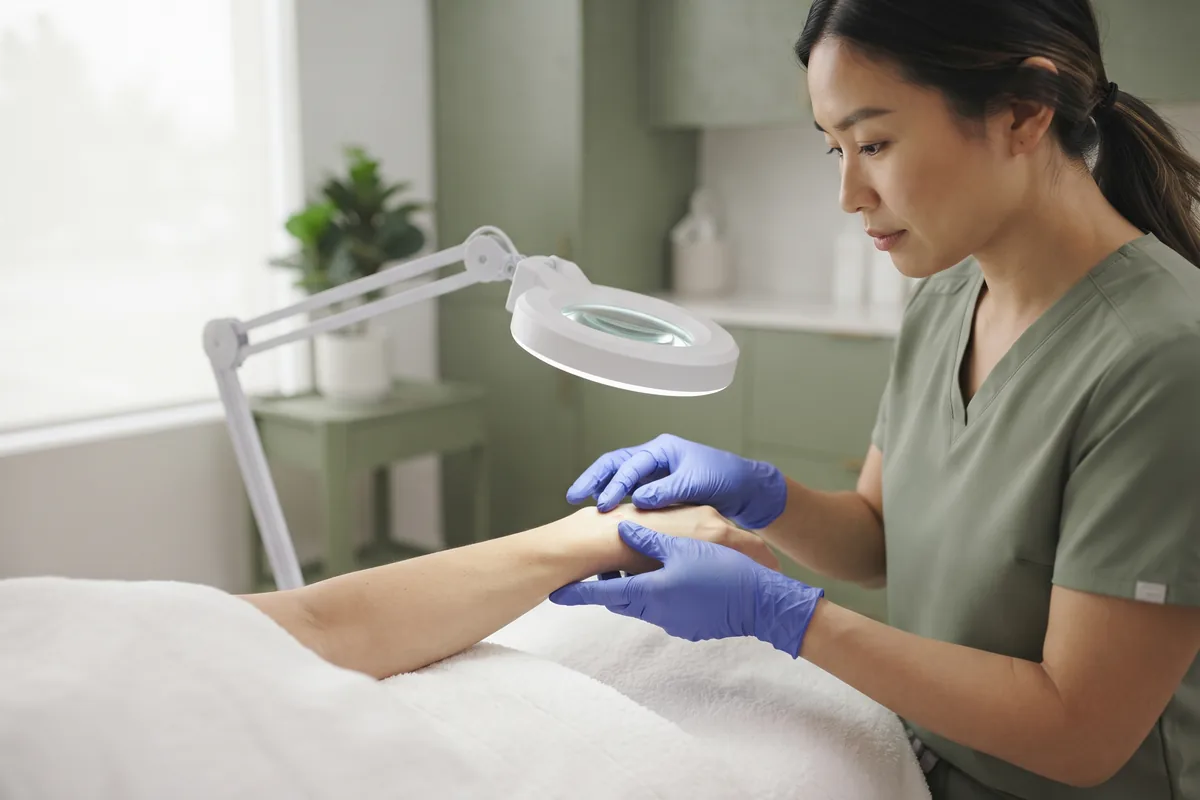
The area is cleansed and lit. I work under a magnifying lamp so I can see the hair and the direction it leaves the skin.
The probe follows the hair. A sterile probe, finer than the hair, slides alongside the shaft into the follicle. It should glide without force. Resistance usually means the angle is off, and I withdraw and try again.
The current is applied. A foot switch or hand switch controls it, and the time is short. Galvanic takes longer, thermolysis is brief and blend sits in between.
The probe is withdrawn. A hair that was treated well lifts out of the follicle with tweezers without any tug. If it resists, I treat that follicle again.
The next hair. A session is hundreds or sometimes more insertions, depending on the area and the time booked.
The skin is soothed. I finish with a calming product and give aftercare instructions.
Notice that none of these steps depends on the label on the machine. Where the probe goes, how deeply, and for how long, is the part that determines whether a follicle is actually treated. This is why two electrologists using the same device can get different results, and why the practitioner matters more than the technology.
Galvanic Electrolysis
Galvanic is the oldest form. A gentle direct current passes through the probe into the natural salt moisture in the follicle. This triggers a chemical reaction that forms sodium hydroxide, which you may know as lye. The lye breaks down the cells at the base of the follicle that produce hair.
Because it relies on chemistry rather than heat, galvanic is slower. A single hair can take from several seconds to a couple of minutes, depending on the settings. Some practitioners use several probes at the same time to speed it up.
Where it shines:
Coarse, deep or curved follicles. The chemical action spreads through the follicle, so it does not depend on the probe touching one exact spot.
Skin that reacts to heat. There is little heat, so some sensitive clients tolerate it better.
Clients who cannot have thermolysis. More on that in the safety section below.
Trade-offs: The sessions can be longer for the same number of hairs, and the area needs time to heal, since the chemical effect continues after the probe is withdrawn.
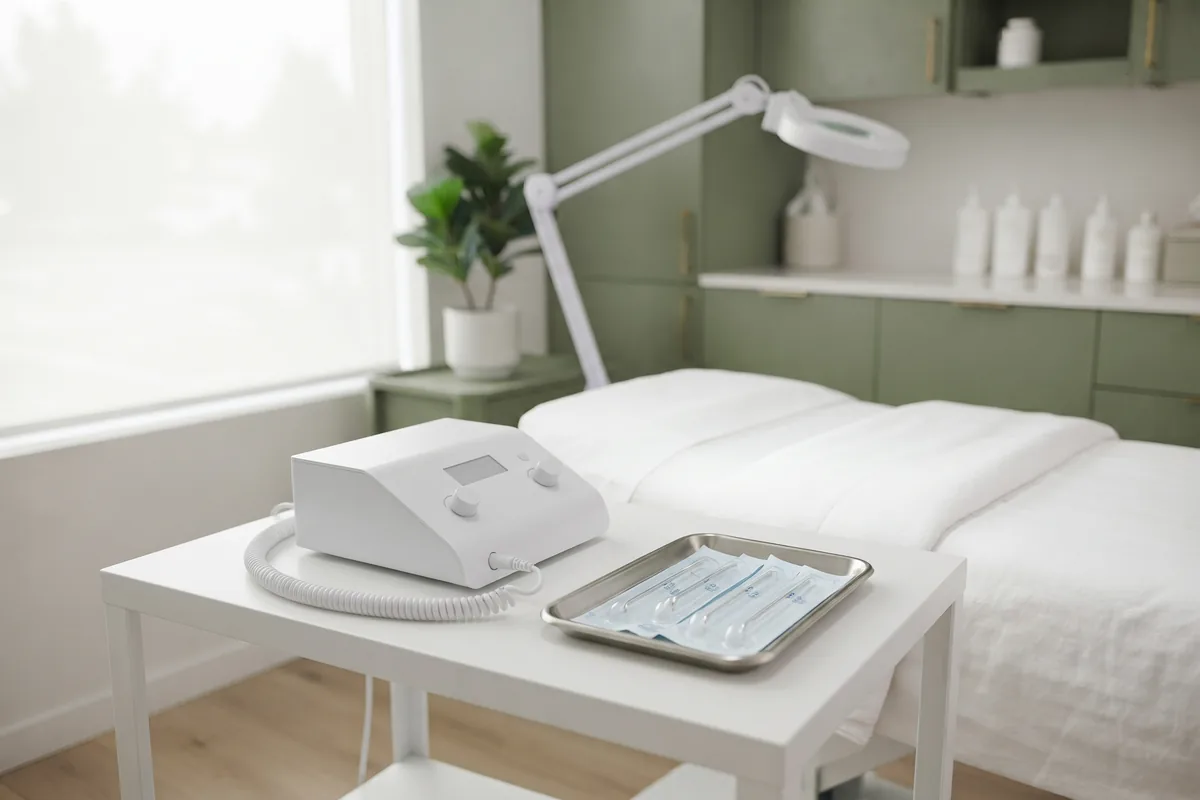
The machine delivers the current. The skill is in placing the probe accurately in each follicle.
Thermolysis (Short-Wave)
Thermolysis uses high-frequency alternating current, sometimes called short-wave. The current makes water molecules in the surrounding tissue vibrate, and the friction creates heat at the tip of the probe. That heat coagulates the cells at the base of the follicle.
It is fast. A hair can be treated in a fraction of a second to a few seconds. That makes it well suited to larger areas with many hairs, because more follicles are treated in the same appointment.
Where it shines:
Fine and medium hair. Quick treatment of many small hairs is efficient.
Large areas. Legs, arms and back go faster per hair.
Clients who prefer short, sharp sensations to a lingering warmth.
Trade-offs: Heat is spread through the tissue around the probe, so accurate insertion matters. If the probe is not at the correct depth or the energy is set too high, the result can be incomplete treatment or irritation. Some practitioners use a higher-power, shorter variation known as flash thermolysis, which suits certain hair types. Thermolysis is also not suitable for clients with a pacemaker or similar implanted device, so those clients need a different method.
Blend Electrolysis
Blend combines both currents in a single insertion. The galvanic current starts the chemical reaction. The high-frequency current adds a short burst of heat that speeds the reaction up and helps spread it through the follicle. The result is a faster treatment than galvanic alone, with less heat than thermolysis alone.
Many practitioners treat blend as a reliable all-rounder, especially for follicles that are coarse, curved or have been distorted by years of waxing or plucking. It gives a second chance to reach a follicle that thermolysis alone might miss.
Where it shines:
Coarse hair where thermolysis alone might be incomplete.
Mixed hair types in one area. The balance works across a range.
Stubborn follicles that regrow after earlier treatment.
Trade-offs: It takes longer per hair than thermolysis, and the sensation can include both the quick flash and a short-lived warmth.
Which Type Is Right for Your Hair?
The honest answer is that a good electrologist chooses by the hair, not by habit. These are the factors I look at:
Hair thickness. Fine hairs usually respond well to thermolysis. Coarse hairs often benefit from blend or galvanic.
Follicle shape. Curved or deep follicles are harder to hit with heat alone.
Body area. The upper lip, with fine, dense hair, is a different job from the bikini area with coarse, curly hair.
Skin sensitivity. Reactive skin may favor lower heat.
Treatment history. Hair that has been waxed or plucked for years may need a different approach than hair that has only been shaved.
Health factors. Implanted devices and certain conditions rule out some methods.
It is common for one session to involve more than one setting. I may start with one setting on fine hairs and adjust for thicker ones in the same area. The settings you are treated with at your first session are not a fixed contract. They change as the hair changes.
Comfort: what each type feels like
Sensation depends more on the area, the hair thickness and your personal tolerance than on the type of current. That said, the three types do feel different. Thermolysis is a quick heat flash. Galvanic is a slower, building warmth or tingle. Blend sits between them. Some clients with sensitive skin say galvanic feels gentler. Others find the longer duration harder to sit through than a quick flash.
If pain is a worry, my electrolysis pain guide covers body-area ratings, numbing cream and how the second session usually feels easier. The method can be adjusted if one feels worse to you than another. Speak up in the session. It is far better to change the setting than to push through.
One practical point: sensitive zones such as the upper lip and bikini line feel stronger whichever current is used, which is why numbing cream is often the bigger comfort lever than the method itself.
Which Areas Tend to Suit Which Approach
These are tendencies, not rules. A good electrologist adjusts for the person in the chair, and hair varies a lot from one body to another.
The price of a session is the same whichever method is used. It follows the area and the time, as listed on the booking page. For example, upper lip is $50 for 20 minutes, chin is $65 for 30 minutes, underarm is $90 for 45 minutes and leg is $150 for an hour.
Hair thickness and follicle shape guide which electrolysis method works best on each area.
Skin Tone, Hair Texture and Method Choice
Electrolysis does not rely on pigment, so it works on every hair color and every skin tone. That is its main advantage over light-based methods. Skin tone and hair texture still shape how I plan the treatment.
Deeper skin tones are more prone to post-inflammatory pigment changes, so I tend to use conservative settings, space insertions apart and stress sun protection afterward. Tightly curled hair grows from curved follicles. Following that curve with the probe takes patience, and a method that works through the whole follicle, such as galvanic or blend, can be a useful option.
Neither factor rules out any of the three types. They guide how carefully each one is used. If you have had pigment marks or raised scars before, mention it at the consultation, and we will build that into the plan.
Settings: Intensity, Time and Probe Size
Choosing a type of current is only the first decision. Every insertion also depends on three settings.
Intensity. How strong the current is. Too low and the follicle recovers. Too high and the surrounding skin takes more of the effect than it should, which raises the chance of irritation, pigment change or marks.
Duration. How long the current flows. Galvanic needs more time to build its chemical effect, and thermolysis needs only a brief pulse.
Probe size. Finer probes suit fine hair and sensitive areas. Slightly larger probes can carry current more effectively into coarse follicles.
I start conservatively, test on a few hairs, and read the skin response and the way the hair lifts. Then I adjust. If you are sensitive, the settings can be lowered and the session paced, though that may mean more visits. The aim is a setting that treats the follicle and respects the skin around it. If you are curious about the aftereffects that come from a setting that is too strong, the upcoming electrolysis side effects guide explains redness, scabs and pigment change in detail.
Myths About Electrolysis Machines
Common claim
What is actually true
The newest machine gives the best results.
Probe placement, settings and technique matter more than the model. A skilled practitioner gets good results with any properly maintained device.
Galvanic is old and outdated.
It is the oldest method and is still used, especially for stubborn or curved follicles.
Thermolysis is painless because it is fast.
It is quick, but a quick heat flash is still a sensation. How much it bothers you depends on the area and your tolerance.
Blend is a marketing gimmick.
Blend is an established method that applies both currents in one insertion.
One method works only on dark hair.
None of the three depends on pigment. Blonde, gray, red and white hairs can all be treated.
A faster method means fewer sessions.
Speed per hair and number of sessions are different things. The count depends on hair density, thickness, hormones and consistency.
When a studio uses a method name as its main selling point, ask how they decide the settings. That answer tells you far more than the name.
What Your First Session Looks Like, Whatever the Method
At the free consultation I look at the hair, check your skin and go through your health history, medications and recent treatments. If there is a medical reason to avoid a method, we choose another. Then we plan the first area, usually a small zone to see how your skin responds.
In the first session I test a handful of hairs, then treat. You will feel a pinch, warmth or tingling at each insertion. Most people find the first few minutes the hardest and then settle into a rhythm. The skin turns pink around the follicles and may have tiny bumps, and a few small scabs can form over the next days. I explain the aftercare before you leave, and the electrolysis aftercare guide covers it in detail.
Between visits, treated hairs shed, new ones surface and the area gets gradually clearer. The method is part of that process, but regular attendance and careful aftercare matter just as much. If you would like to see what a course looks like for your area, you can book a free consultation at the Irvine studio. Clients also come from Tustin, Costa Mesa, Lake Forest and the rest of Orange County.
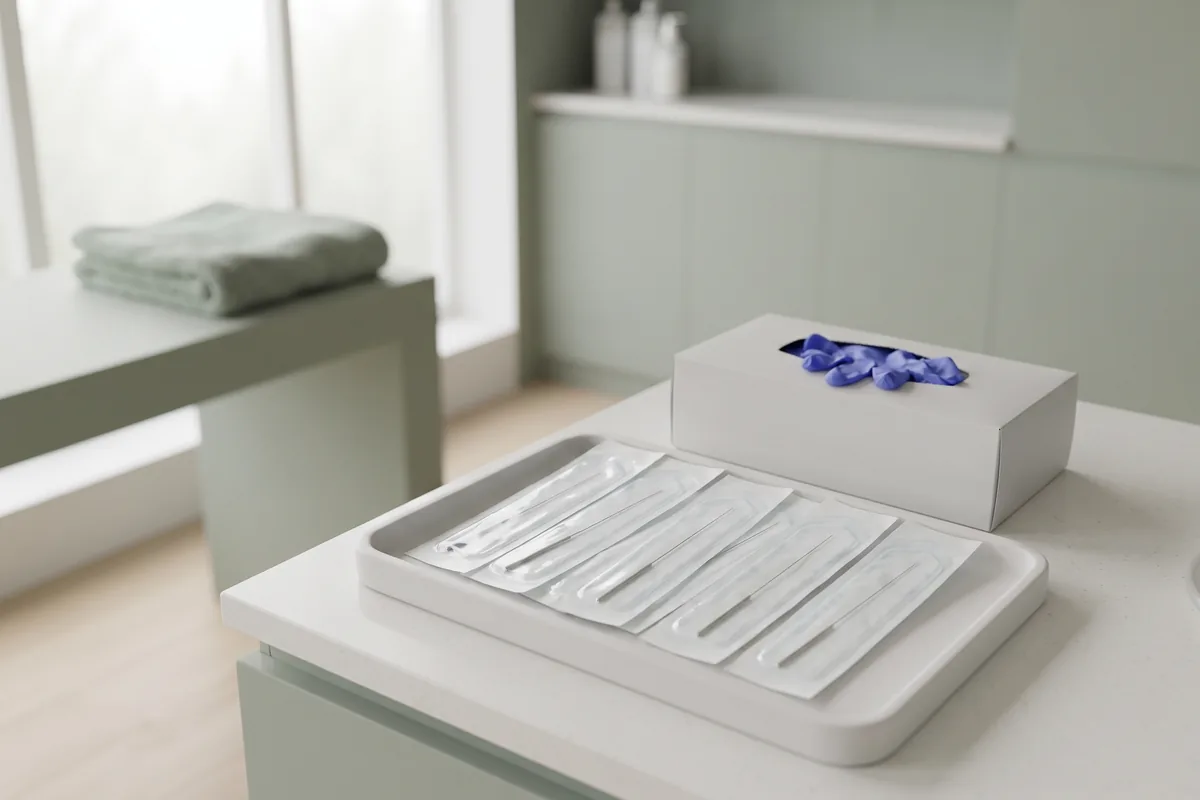
Every method starts with a sterile, single-use probe that is opened for you and discarded after your session.
Safety Notes and Who Needs a Different Method
Tell your electrologist about any of the following before treatment:
A pacemaker or implanted cardiac device. Thermolysis uses high-frequency current that can theoretically interfere with devices. Galvanic may be possible with written approval from your cardiologist.
Pregnancy. Talk to your physician first, and tell me.
Metal allergies. Probes are metal. Tell me about any known sensitivity, such as nickel, and we will choose accordingly.
Medications such as isotretinoin or blood thinners, and any recent skin treatments. Your physician can advise on timing.
A history of keloids or cold sores. Both change how we plan the area.
Whatever the type, the probe is sterile, single-use and discarded after your session. Normal healing involves redness, slight swelling and tiny scabs for a day or two. My aftercare guide lists what is normal and what to report.
Questions to Ask Before You Book
Anyone offering electrolysis should be able to answer these plainly:
Which methods do you offer, and how do you decide which to use on my hair?
Are probes sterile and single-use?
Can you adjust the method if something is uncomfortable?
How do you handle health factors, such as a pacemaker or pregnancy?
What do you expect sessions to look like for the area I want treated?
If you are comparing electrolysis to other methods altogether, the electrolysis vs laser comparison is the next read. If you live in Irvine or elsewhere in Orange County and want a straight answer about your own hair, book a free consultation. The details of what we offer are on the electrolysis page.
Red Flags When a Studio Talks About Methods
Probes are not sterile, single-use or opened in front of you.
Nobody asks about your health history, medications or implanted devices.
A fixed number of sessions is promised before anyone has looked at your hair.
The studio claims one proprietary method works better than all others and cannot say what current it uses.
You are pressured to prepay for a large block of treatments on the first visit.
Questions about licensing, hygiene or technique are brushed off.
None of these is proof of poor work on its own, but each is a reason to slow down and ask more questions. A good practitioner is comfortable explaining what they do and why.
Frequently Asked Questions
+ What are the three types of electrolysis?
Galvanic uses direct current to create a chemical reaction in the follicle. Thermolysis uses high-frequency current to create heat. Blend combines both in one insertion. All three are used to achieve permanent hair removal when performed properly.
+ Which type of electrolysis is the most effective?
No single type is best for everyone. Results depend on accurate probe placement, correct settings, hair type and consistent sessions. A skilled electrologist chooses and adjusts the method for your hair and may use more than one during your treatment.
+ Which type of electrolysis is the fastest?
Thermolysis is the fastest per hair, typically a fraction of a second to a few seconds. Galvanic is the slowest because it relies on a chemical reaction. Blend sits in between.
+ Is galvanic electrolysis less painful than thermolysis?
Not always. Galvanic feels like a slower, building warmth, while thermolysis is a quick heat flash. Some sensitive clients find galvanic gentler, and others prefer the shorter flash. Pain also depends on the area and the hair thickness.
+ Can I have electrolysis with a pacemaker?
Thermolysis is generally avoided with pacemakers and similar implants because of the high-frequency current. Galvanic may be possible with written approval from your cardiologist. Always tell your electrologist about any implanted device before treatment.
+ Does the type of electrolysis change how many sessions I need?
Not by itself. The number of sessions depends on hair density, thickness, treatment history, hormones and how regularly you attend. The method affects the speed and comfort of each session more than the total count.
+ Can I switch methods in the middle of treatment?
Yes. A good electrologist adjusts the method and settings as your hair and skin respond, and may use more than one type in a single session. Tell your electrologist if one setting feels harder than another.
+ Does the brand of the electrolysis machine matter?
Much less than the practitioner. All machines deliver one of the three types of current. Accurate probe placement, correct settings, sterile single-use probes and consistent care determine how well treatment works.
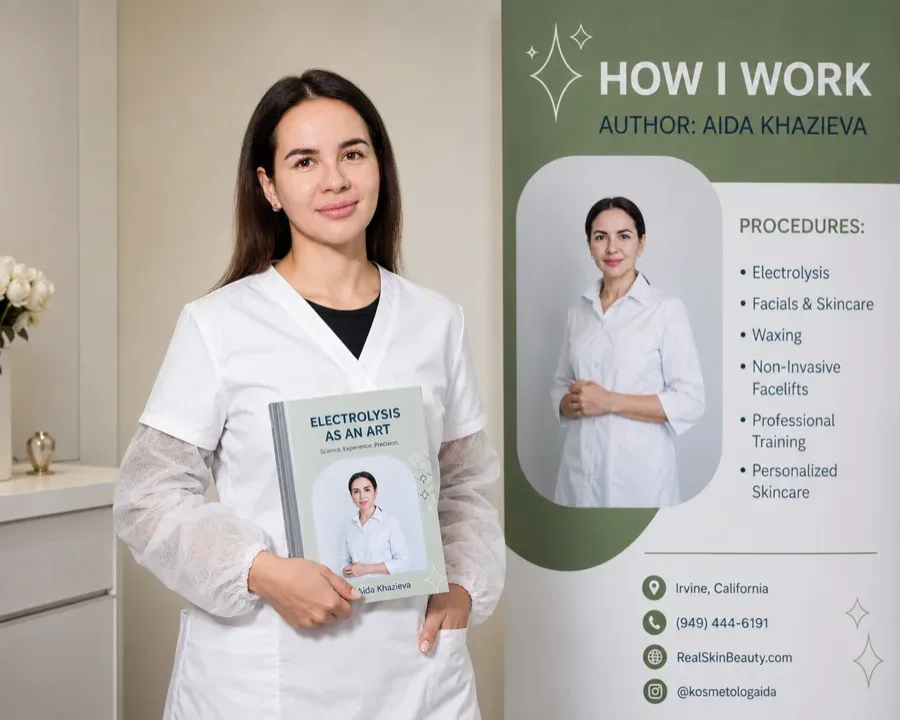
Licensed electrologist and cosmetologist with 20+ years of experience. Aida sees clients at Real Skin Beauty, 18021 Sky Park Circle, Suite N, Irvine, CA 92614.
Book a free consultation with Aida Khazieva at Real Skin Beauty in Irvine, CA. She will look at your hair and explain which method and settings suit your treatment area.
This article is for informational purposes and reflects Aida Khazieva's professional experience. It does not replace a personalized medical consultation. Individual results vary.
Questions? Aida Answers Them All.
Visit our FAQ or book a free consultation to discuss your specific skin and hair concerns.